FLAC
FLAC-specific IO lives behind the same read/download split. Decoding uses
soundfile, whose wheels bundle libsndfile, so nothing needs to be on PATH.
A time window [start_sec, end_sec) is cut by sample index:
[round(start_sec * sr), round(end_sec * sr)).
How a FLAC file is laid out
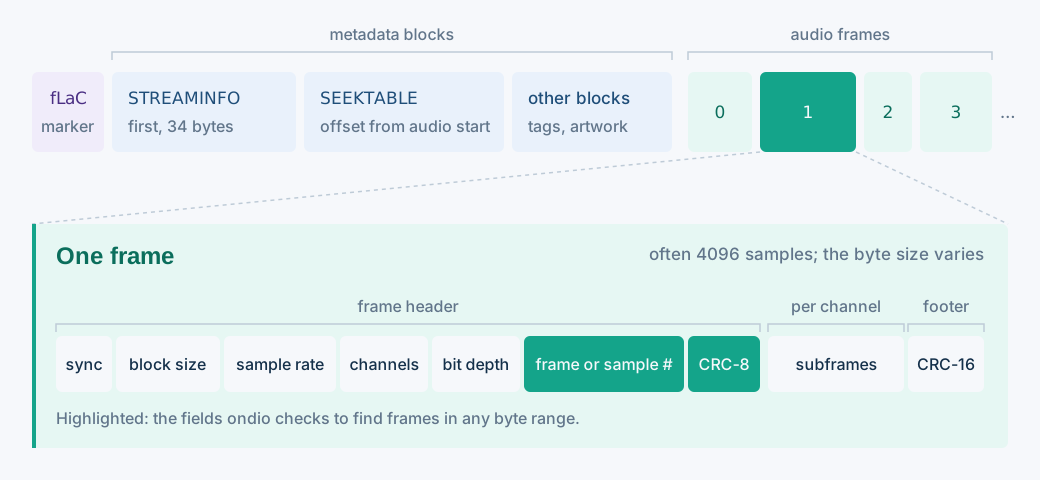
A FLAC file has three parts, in order: the four bytes fLaC, a run of metadata
blocks, and the audio frames. The format is specified in
RFC 9639.
Metadata blocks. Each block starts with a 4-byte header: a flag marking the last block, the block type, and the length of the body. The length lets a reader step over a block without reading its body.
- STREAMINFO is always first and always 34 bytes. It holds the sample rate,
channel count, bits per sample, and total number of samples.
extract_flac_headerreturns it as aFlacHeader. A total of 0 means the encoder did not know the length; windowed reads require a known length and raiseOndioErrorwhen it is unknown. - SEEKTABLE is optional. Each seek point pairs a sample number with the byte
offset of the frame that starts there, relative to the first audio frame.
ondiouses it to estimate where a window's bytes are. - Other blocks, such as tags, embedded artwork, and padding, are skipped during metadata parsing. The initial 4,096-byte read can include some or all of a block, but the parser does not fetch the rest of its body.
Audio frames. Each frame holds a block of consecutive samples for every channel. Its header starts with a sync code and gives the block size, sample rate, channels, and bit depth, then the frame's position in the stream: a frame number when every frame holds the same number of samples, or the number of its first sample when they differ. A CRC-8 checks the header. The subframes follow, one per channel, holding the compressed samples, and a CRC-16 checks the whole frame.
Byte offsets are not times. Frames usually hold the same number of samples,
but how well they compress depends on the sound, so their sizes in bytes vary. A
byte offset computed from the average bitrate can land far from the time it was
meant for; on long recordings this put older ranged reads off by about 30 s (see
Migrating from soundhub_utils).
ondio reads the true position from the frame headers in the fetched bytes
rather than trusting the estimate; see
Ranged FLAC reads for how.
Header
extract_flac_header parses the STREAMINFO block, fetching an initial range and
any additional metadata block headers needed,
never the audio.
import ondio

header = ondio.extract_flac_header("s3://my-bucket/audio/rec.flac")
header.sample_rate, header.channels, header.duration
Decoding a window
read_flac with a window decodes it to PCM, like libsndfile: a float32 array of
shape (frames, channels) in [-1, 1], plus the sample rate.
samples, rate = ondio.read_flac("s3://my-bucket/audio/rec.flac", 60.0, 63.0)
FLAC bytes in memory
decode=False returns FLAC bytes instead. With a window, they are a standalone
.flac of that window, re-encoded losslessly. With no window, they are the
original file's bytes exactly, with no decoding.
clip = ondio.read_flac("s3://my-bucket/audio/rec.flac", 60.0, 63.0, decode=False)
raw = ondio.read_flac("s3://my-bucket/audio/rec.flac", decode=False)
Clips on disk
download_flac writes a local .flac file. With a window, it cuts the clip; with
no window, it is a plain byte-for-byte download.
ondio.download_flac("s3://my-bucket/audio/rec.flac", "clips/rec_60-63.flac", 60.0, 63.0)
ondio.download_flac("s3://my-bucket/audio/rec.flac", "data/rec.flac")
Windowed reads of remote files
Windowed reads of large remote files fetch only a byte range around the window
instead of the whole object. The ranged path is chosen automatically for files
over 50 MB when the window is under a third of the stream duration;
use_range=True/False forces either path. A ranged read that succeeds returns
exactly the samples a full download would.
Widening a ranged read fetches each audio byte at most once, usually in a few requests. The initial metadata read can overlap the audio range, so total transfer can exceed the file size. A file with no seek table and a very uneven bitrate can make the read fetch a large part of the file. Ranged FLAC reads explains how the window is found.
Damaged input raises an error on both paths. A window that reaches into a corrupt
or truncated region raises OndioError. A file whose header overstates its
length (truncated recorder files exist) raises for windows past its real end.
Windows clear of the damage read exactly. If the damage is in the bytes already
fetched, the ranged read raises without fetching more. A ranged failure names
use_range=False: a full download is never started on your behalf.
Over HTTP, a windowed read_flac or download_flac, and extract_flac_header,
need a server that honors range requests and sends a Content-Length, whatever
use_range is: the header is always read with a range request, and the file size
is always checked. Without them these calls raise UnsupportedOperationError. To
read from such a server, read the whole file with read_flac(url) and cut the
window yourself, or download it and read the local copy.