Architecture
ondio defines a unified interface for reading/writing files across different platforms, where the target platform is inferred based on the structure of the URI. The URI structure is used to dispatch to platform specific implementations, combining the strategy and registry design patterns.
Each call resolves a backend from the URI scheme and delegates to it. A caller can
also build a backend once and pass it as backend=; the call then uses that backend:
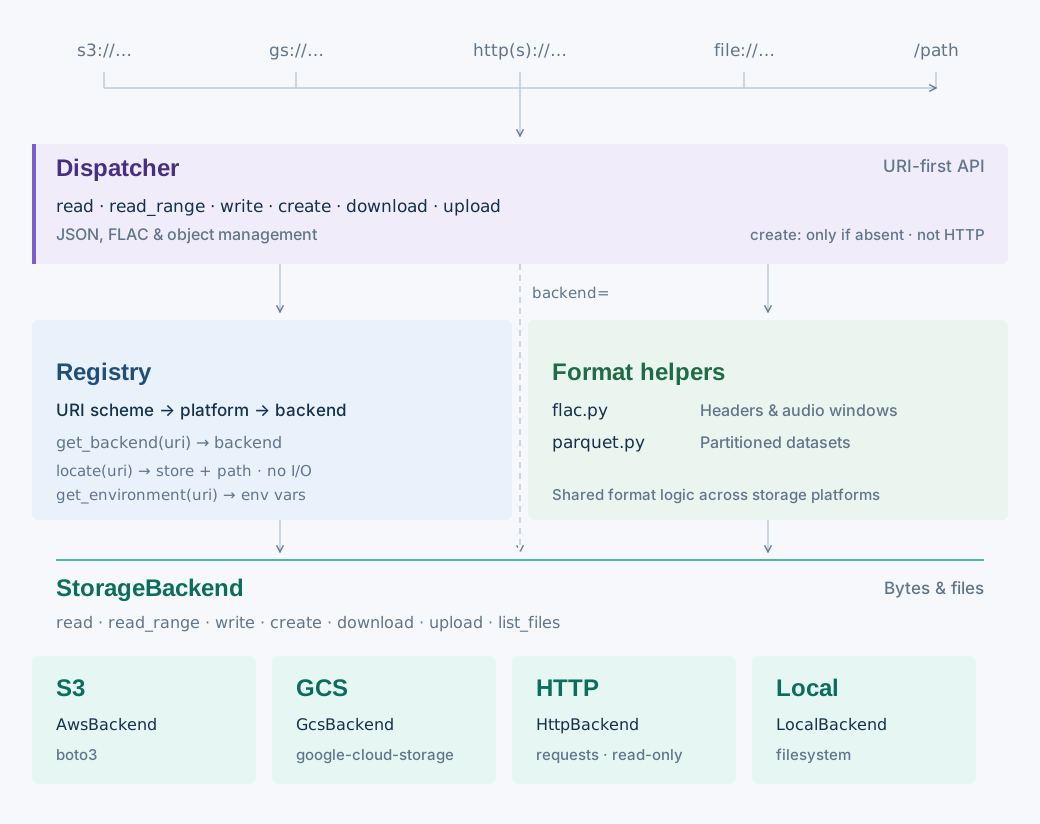
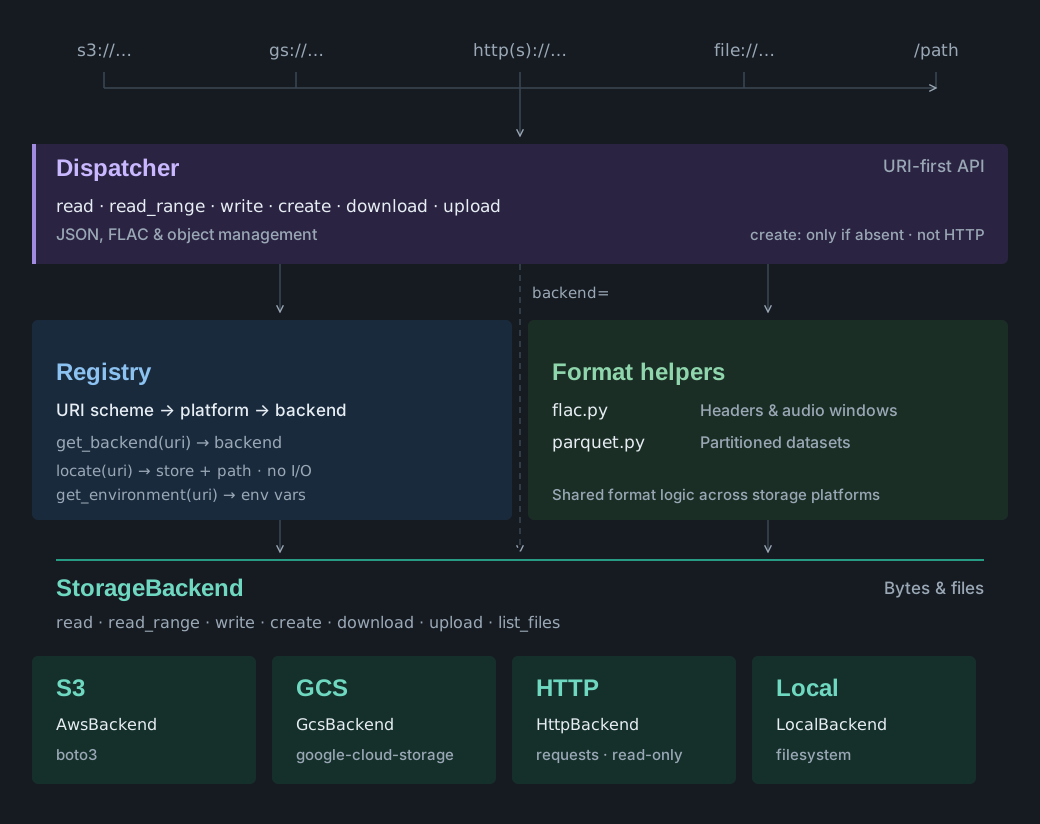
- dispatcher — what callers import: every function takes a URI, infers the platform, and delegates, or uses the backend given as
backend=. No platform types leak out: SDK errors arrive asondioerrors, with the SDK error as the cause. - registry — the strategy lookup: maps the URI scheme to a platform name and lazily constructs that platform's backend.
- format helpers — FLAC and Parquet logic written once against the backend protocol, so partial FLAC reads work identically on S3, GCS, HTTP, and local files. FLAC decoding and encoding use
soundfile(libsndfile, bundled in its wheel). - backends — one class per platform implementing the byte-level protocol (
read_rangeis what makes partial reads cheap on remote files); each wraps its platform SDK and translates its errors toondio's exception types.
Layers
ondio follows a layered structure. The primary layer users interact with is the
public API: generic read/write methods plus format-specific ones.
The second layer is the registry, which maps URI schemes to appropriate backends, and
specific helpers for .flac and .parquet files. File-format specific logic only lives at
this layer — the backends only operate on bytes and arbitrary files on disk, and never
implement format-specific logic.
Ranged FLAC reads
A windowed FLAC read of a large remote file fetches a byte range instead of the whole object (when). FLAC frames vary in size (why), so the bytes that hold a time can only be estimated. The read therefore estimates first and then checks what it fetched:
- Estimate.
ondiointerpolates between the seek table's points to guess which bytes hold the window, with some slack on each side. Without a seek table, it uses the average bitrate. The estimate only chooses what to fetch. - Find frames. In the fetched bytes,
ondiolooks for frame headers: a sync code, fields that agree with STREAMINFO, and a matching CRC-8. A random byte pattern still passes these checks about once in a few thousand, so it keeps only a chain of frames whose frame or sample numbers continue one another. The headers give the sample position of each frame in the chain. - Widen. If the chain does not cover a side of the window, that side is widened, by more each round, and fetched. Widening fetches only new audio bytes. The initial metadata read can overlap the audio range, however, so total transfer can exceed the file size.
- Decode. The frames that hold the window are wrapped in a minimal stream
(the marker and STREAMINFO, then the frames) and decoded with
soundfile. The window is cut from the result by sample index.
A false frame that passes the header checks can still join a chain. The frame's
CRC-16 and decoded sample count provide further checks, but checksums are not
collision-proof and cannot guarantee that every false frame is detected. The
read raises OndioError, naming
use_range=False, when the chain breaks inside the window, when it cannot cover
the window even at the edge of the audio, or when the decode fails. It never
starts a full download on its own.